Ebook Free Atheist Overreach: What Atheism Can't Deliver, by Christian Smith
If a publication from popular author is presented, at some time several followers of them will directly buy guide. Also any kind of publication kinds, however are they truly reading guide? Who recognizes? Thus, we will reveal you a publication by acquainted writer qualified Atheist Overreach: What Atheism Can't Deliver, By Christian Smith This publication will certainly offer you some advantages if you actually reviewed it. The initial is you can get the new words as exactly what we have actually not known about it formerly. We can likewise enhance the foreign language from reading this publication. There are any kind of.
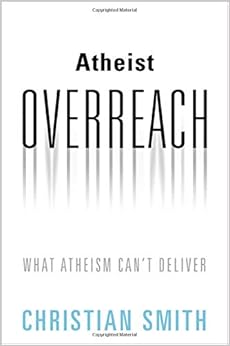
Atheist Overreach: What Atheism Can't Deliver, by Christian Smith

Ebook Free Atheist Overreach: What Atheism Can't Deliver, by Christian Smith
Checking out a publication Atheist Overreach: What Atheism Can't Deliver, By Christian Smith is sort of easy task to do whenever you desire. Even reading every time you really want, this activity will certainly not disrupt your various other activities; many individuals generally check out the books Atheist Overreach: What Atheism Can't Deliver, By Christian Smith when they are having the extra time. Just what concerning you? Exactly what do you do when having the leisure? Do not you spend for ineffective points? This is why you have to obtain the book Atheist Overreach: What Atheism Can't Deliver, By Christian Smith and try to have reading behavior. Reading this book Atheist Overreach: What Atheism Can't Deliver, By Christian Smith will certainly not make you ineffective. It will certainly give more perks.
When you have actually chosen to search for the brand-new publication title coming as the latest book collection. Finding the title based upon the topic right here is so very easy. You could not feel so hard to find it because we ways make the listings of what's new in the site. Also this site provides you the links to obtain the soft documents of the book; we always offer you the best that can alleviate to locate guide, as the Atheist Overreach: What Atheism Can't Deliver, By Christian Smith that we have recommended.
The reason of lots of people selects this Atheist Overreach: What Atheism Can't Deliver, By Christian Smith as the referral exposes due to the demands in this day. We have some certain methods just how the books are presented. Beginning with the words choices, linked topic, and easy-carried language style, just how the author makes this Atheist Overreach: What Atheism Can't Deliver, By Christian Smith is really easy. But, it showcases the professional that can affect you simpler.
Now, when you have an additional suggestion to select guide, just what you can do? It will be far better and simpler to discover Atheist Overreach: What Atheism Can't Deliver, By Christian Smith in this site since we offer you the straight link to go to the book site. It will certainly be a lot easier and also faster to obtain it. Right here, soft documents will actually aid you to save and read it whenever you want. Of course, it will not restrict you to read it in certain area.
Review
"Many essays and books have been written in response to the anti-theistic polemics of the so-called New Atheists. Christian Smith's Atheist Overreach is the equal of any of those writers in his acquaintance with the relevant literature and in the acuity of his critique of the claims of the New Atheists. What makes his book stand out from the crowd is that he is writing for the general reader, rather than specialists, that he never overreaches in what he claims to have established, and that -- unlike much of the writing on both sides -- he is never abusive of those whose views he is critiquing. The style is lucid and engaging. In every way, an admirable contribution to the debate." -- Nicholas Wolterstorff, Yale University "Clearly and accessibly written, Atheist Overreach eschews polemics on a topic that usually evokes nothing else. Christian Smith raises questions that every thoughtful atheist must deal with." -- James W. Jones, author of Can Science Explain Religion? The Cognitive Science Debate"This book provides an invaluable resource for believers and nonbelievers to dialogue about important moral questions, presenting a thorough and readable evaluation of the claims of authors who write as a moral voice of atheism in the public square. At a time when we struggle to have civil discussion about challenging issues such as religion, Christian Smith's balanced approach will undoubtedly help launch an important, productive dialogue among atheists, religious believers, and those who are not sure." -- Margarita Mooney, author of Faith Makes Us Live: Surviving and Thriving in the Haitian Diaspora"Incisive... Smith's powerful arguments never collapse into apologetics or defense of theism, but instead offer crucial weak spots for atheists to consider. These thoughtful essays and their refreshingly balanced approach will appeal to a general audience searching for clarity and precision in considering the shortcomings of atheist debates." --Publishers Weekly"Atheist Overreach: What Atheism Can't Deliver by Christian Smith is a well-balanced collection of essays seeking to point out certain weak spots in some of the less modest atheist claims with respect to ethics, the relation between science and religion, and finally, the question of whether humans are naturally religious."--Religion Watch"I highly recommend you read this book. It'll sharpen your thinking and equip you to help others dissect common atheist claims. Importantly, its tone isn't that of a gleeful take-down, but rather a careful critique of ideas."--The Gospel Coalition
Read more
About the Author
Christian Smith is William R. Kenan Jr. Professor of Sociology at the University of Notre Dame. Smith holds an MA (1987) and PhD (1990) in Sociology from Harvard University and has studied at Harvard Divinity School. He has taught at Notre Dame, the University of North Carolina at Chapel Hill, and Gordon College, MA.
Read more
Product details
Hardcover: 168 pages
Publisher: Oxford University Press (December 1, 2018)
Language: English
ISBN-10: 0190880929
ISBN-13: 978-0190880927
Product Dimensions:
8.2 x 1 x 5.8 inches
Shipping Weight: 10.4 ounces (View shipping rates and policies)
Average Customer Review:
3.8 out of 5 stars
5 customer reviews
Amazon Best Sellers Rank:
#150,292 in Books (See Top 100 in Books)
In the past decade and a half, Christopher Hitchens and Richard Dawkins have really driven the debateand inspired seemingly dozens of responses on behalf of religion. Smith focuses on lesser known authors,but the most prominent are probably Sam Harris and Yuval Noah Harari. Another interesting aspect ofthis discussion would be Neil de Grasse Tyson on Stephen Colbert's show, where Colbert offered anumber of insights into the relationship between faith and empirical evidence.Smith makes a number of provocative critiques of atheism, but his goals are modest. The book is nota refutation of atheism or a proof for religious faith, Christian or other, but an analysis of what theatheists themselves are arguing for. Atheism and naturalism are not identical (one can be a pantheist,for instance), but often overlap, so the first two chapters are really an extended argument. Smith'sargument is that while atheists have good reason to be moral on a number of grounds, atheism doesnot support the lofty humanistic and humanitarian ideals that many atheists strive for, such as "universalbenevolence" and causes of human rights. He notes that Hume's example of the "cunning knave" isquite compelling unless there is a God, and Kant's system, which some atheists have adopted, presupposesa God even if he cannot be demonstrated by reason. Smith also argues that nonbelievers might make betteruse of Aristotle's virtue ethics, which also presupposed the unmoved mover but can be adopted justas well as Kant. In terms of Kohlberg's moral development, you might say that atheism can attainthe middle levels of being socially acceptable and conventional, but why achieve universal benevolencelike Gandhi or Martin Luther King (who, needless to say, acted out of Christian convictions)?The third chapter discusses the atheists and the scientists who venture into philosophy, metaphysicsand theology, or anti-theology. Again, he largely overlooks Hitchens and Dawkins because so manyhave responded to them, but takes note of the criticism of Dawkins by Terry Eagleton (a CatholicMarxist critic, whatever that is, but helpful in this context). He discusses the notions of "turf"and the proper domains of science, metaphysics and theology, and actually goes beyond thenotion of turf but that's a helpful concept to see what he's talking about. The fourth and finalchapter discusses whether humans are naturally religious and thus whether secularism willinevitably reach a limit and yield to revivals of faith. Of course many individuals live withoutreligion, and some are very moral as this entire book acknowledges. But the drive for religionalso includes quests for transcendence such as drugs and alcohol, sexual activities, intellectualand aesthetic drives that all seek to go beyond the mundane and suggest more to realitythan the visible and empirical aspects of the world.
This book again demonstrates sociologist Christian Smith's exceptional intellectual range and clarity of thought. In four essays, he exposes the extent to which atheist moralists (including Philip Kitcher, Sam Harris, Greg Epstein, and Lex Bayer and John Figdor) lack any good reasons for the convictions they assert about the reality of human rights and the imperative of benevolence toward all human beings; the embarrassing ignorance and arrogance of scientists who think the findings of the natural sciences disprove or even weaken convictions about the reality of God as understood in the world's major religious traditions; and the sense in which all human beings can be understood as naturally religious quite apart from their particular convictions and contingent cultural contexts. It's not, as Smith makes clear, that atheists *can't* believe in the reality of human rights, or act in human solidarity with those they've never met, or believe that everyone should care about and seek the well-being of others. It's rather that, in a naturalist universe with no inherent meaning or purpose, there are no good arguments they can make or evidence they can marshal to convince skeptics who would rather just look after themselves, their families, and their friends. Let's see whether any atheists interested in more than polemics, and who show they have actually understood the force of Smith's arguments, can mount a remotely convincing response.
This was a strange book because he seems to be criticizing is own project. By the end of the book, I was genuinely expecting some sort of "just kidding" or explanation that Smith was performing a meta-critique by doing exactly what I was criticizing to show how bizarre it was. But the irony is apparently lost on him.Let me explain this a little. He's a sociologist doing some extremely weak philosophy- specifically, metaethics, political philosophy, and philosophy of religion (all about as bad as you expect) in the first two chapters, and then makes the following claims in Chapter Three-"...certain well-known science authors, often writing for popular audiences, seem to feel entitled not only to write with authority about science but also to pronounce on metaphysics and religion," and "Here is my bottom line. To all amateur scientific interlopers into metaphysics and theology, I say this: stop overreaching. Please stick to what you are good at, to science proper, and stop doing half-baked philosophy...."I could not have said it better, and I am not sure how he misses the fact that he is doing the exact same thing he (rightly) criticizes Dawkins for doing. Dawkins is a biologist doing armchair metaphysics. Smith is a sociologist doing armchair ethics, etc. Neither leaves the philosophy to the philosophers.Without agreeing or disagreeing with his thesis, his ethics chapter fall short in two huge ways- first, he tries to address and refute everyone, which means he succeeds at refuting no one. His claims are so sweeping and his generalizations so hasty that this chapter would not merit a passing grade in one of my introductory philosophy courses. Second, because of his unfamiliarity with the field of ethics, he mostly misses the point of those he is trying to criticize.His general point is that atheist philosophers don't provide a god-free ground for universal ethics. This should not surprising or problematic, given that they are usually about writing philosophy of religion and not ethics. However, what Smith misses is that they don't (and shouldn't) feel the need. In metaethics, the three biggest theories for sources of value are consequentialism (such as utilitarianism), deontology (such as Kantian ethics) and areteic ethics (such as Aristotelian virtue ethics). Any of these supply a universal ground for ethics, but NONE OF THESE THEORIES REQUIRE A GOD. Hence, an atheist saying we don't need God for ethics is just saying, "we can use any of the three leading contenders of ethical value in order to have ethics without God" and simply defer the defense of those systems to the ethicists who do that professionally. They need not do so themselves as part of philosophy of religion. They simply trust ethics to ethicists, a move which Smith should support given that he wants scientists to do science, but instead fails to grasp at its most fundamental level. Given there are so many popular secular sources for universal ethics, Smith would need to refute them all to succeed, an ambitious project which he does not attempt. He should follow his advice and leave the ethics to the professionals. His criticism of the sources of rights is similarly sloppy and based on straw men.Overall, while this is not the sloppiest text I have ever read, it is the sloppiest I've read that is published by Oxford.
Atheist Overreach: What Atheism Can't Deliver, by Christian Smith PDF
Atheist Overreach: What Atheism Can't Deliver, by Christian Smith EPub
Atheist Overreach: What Atheism Can't Deliver, by Christian Smith Doc
Atheist Overreach: What Atheism Can't Deliver, by Christian Smith iBooks
Atheist Overreach: What Atheism Can't Deliver, by Christian Smith rtf
Atheist Overreach: What Atheism Can't Deliver, by Christian Smith Mobipocket
Atheist Overreach: What Atheism Can't Deliver, by Christian Smith Kindle

Tidak ada komentar :
Posting Komentar