PDF Ebook The Nibelungenlied: Prose Translation (Penguin Classics), by A. T. Hatto
When it requires factors to consider to choose such book to read in referring to the significant problem that you have currently, you need to attempt with this book. The Nibelungenlied: Prose Translation (Penguin Classics), By A. T. Hatto, nevertheless, ends up being an extended publication does not suggest that this book is rarely thoughtfully. You can transform your mind set about the very best publication will showcase one of the most hard language and words to recognize. This case will certainly certainly make nonsense for some individuals.
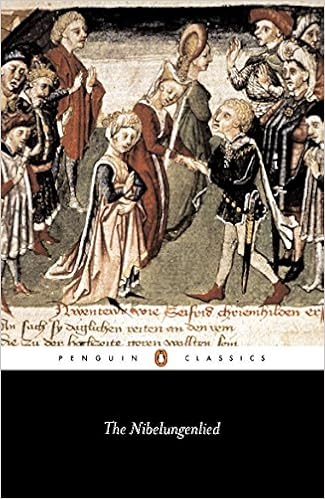
The Nibelungenlied: Prose Translation (Penguin Classics), by A. T. Hatto

PDF Ebook The Nibelungenlied: Prose Translation (Penguin Classics), by A. T. Hatto
Required an assistance to find the brand-new released publication? Don't bother! Don't believe so hard due to the fact that we are constantly into aid you. Whoever you are, to discover the book, from numerous nations, is currently easy. Here, we have the lots collections of various types and genres of the books. The books are provided in soft file systems as well as you can find the web link for each and every book to download and install.
Just what do you consider The Nibelungenlied: Prose Translation (Penguin Classics), By A. T. Hatto as one that we provide currently? This is a wonderful book that belongs to the upgraded lately book to release. When great deals of individuals attempt to get this publication trouble, you can be much easier to accompany us and seek for it for simpler methods. As well as this is you time to notify your buddy regarding this excellent news. Supplying the excellent information concerning this publication to others will certainly ease then not to obtain trouble any more, additionally for better details.
We offer The Nibelungenlied: Prose Translation (Penguin Classics), By A. T. Hatto that is written for addressing your concerns for this time around. This suggested publication can be the reason of you to lays extra little time in the night or in your workplace. However, it will certainly not disturb your tasks or obligations, obviously. Managing the time to not only get as well as read the book is really easy. You could just need couple of times in a day to end up a page to some web pages for this The Nibelungenlied: Prose Translation (Penguin Classics), By A. T. Hatto It will certainly not fee so hard to after that finish guide up until completion.
read. Why? Once more, this is so appropriate with the topic that you really need currently. It will likewise make your selection of the day to load the time by reading this book. Even it is a sort of soft file forms, The Nibelungenlied: Prose Translation (Penguin Classics), By A. T. Hatto material will not be different with the print out of the book.
Product details
Paperback: 416 pages
Publisher: Penguin Classics; Reprint edition (April 30, 1965)
Language: English
ISBN-10: 9780140441376
ISBN-13: 978-0140441376
ASIN: 0140441379
Product Dimensions:
5.1 x 1 x 7.7 inches
Shipping Weight: 11.4 ounces (View shipping rates and policies)
Average Customer Review:
4.2 out of 5 stars
39 customer reviews
Amazon Best Sellers Rank:
#256,587 in Books (See Top 100 in Books)
A fabulous tale with multiple layers of myth and history. This is the first translation of this tale I've ever read so I am in no position to judge the the story on those grounds but, strongly suspect, that I read old German--with all its alliterations and kennings--that the tale would be all the better. The medieval poet, whoever he was, who finally penned these lines, knowingly or unknowingly, altered the original pagan tale replete with Odin, Loki, Fafnir, dwarves, water fairies, weird, Gunther, Attila [Etzel], Burgundians, Thuringians, Huns and many others. The first part of the tale is almost purely mythic. The second part of the tale is an echo of the disasters that befell, not only the Burgundians, but many other Germanic tribes and Atilla's Huns, as well. As such, the tale is a reflection of the disaster the first Burgundian Empire experienced at the hands of the Huns and Aetius [Lord of Verona?] and the final apocalyptic Battle of Challlons where Aetius allied with the Visigoths and other Germanic allies, including the Burgundians, crushed the Huns allied by the Ostragoths and other east and south German forced allies. Tens of thousands died on the plains a Cataulunia. A short time later, Atilla, himself, dies following a wedding feast in which he is wed to a German princess. Scant records indicate he died of a nosebleed [?] in his matrimonial bed before consummating the marriage. Many believe that the young woman managed to kill her would-be lover.It's all there in the Niebelungenlied but in vastly altered form. Like the King Arthur fable, the tale is heavily encrusted with 'modern', medieval customs and references. Still, I'm taken with how much, indeed, this story resembles Homer's the Iliad and Odyssey and wonder if the poet borrowed from Homer's masterpiece? On the other hand, the tale has a long history, perhaps going back to the 6th Century in a largely illiterate Central Europe and Scandinavia. Therefore, it is possible that the Iliad, Odyssey, Niebelungenlied and Poet Edda, all have a common origin. Siegfried and Achilles have a great deal in common, more than can be attributed to pure chance. Achilles' goddess mother, holds the newborn Achilles by the ankle and dips him in a sacred river. The water makes his skin invulnerable to wounds. Of course, the water doesn't touch the skin of one ankle where is mother holds him.Odin, in the guise of a one-eyed old man, tells Sigurd [Sigfriend] how to kill Fafnir, the enchanted dragon. He also tells him that he must then wash himself in the dragon's blood so that his skin will become hard [like a dragon?] and invulnerable to wounds. During his blood bath, however, a leaf falls in the upper middle of Sigurd's back, so the blood never touches it with Achilles-like ultimate results. Also, the final chapters of the story in which Hagen, Gunther and all the Burgundian knights attempt to fight off multitudes of Huns and Hun-allies is stylistically very much like scenes of battle told in the Iliad. At one point, Hagen holds his enemies at bay 'like a boar in the forest.' An almost identical line occurs in the Iliad when a hard-pressed Odysseus fights off the Trojans 'like a boar in the forest.' Of course, lines like these could have been part of long-standing Indo-Europeans traditions.In addition, I'm struck by a similarity to the Holy Bible, itself. Hagen asked Kriemhild the point at which her husband, Sigfried, is most vulnerable. Thinking Hagen literally wants to cover Sigfried's back, she tells the truth with fatal results. In the Bible, Delilah badgers Samson about the source of his strength. Samson finally admits the truth, "It's my long hair," which Delilah cuts off with fatal results. A fascinating tale with numerous layers.
If you are expecting the story of Siegfried as told by Wagner, forget it. Some of the names and plot points are the same, but this is very different. This is a 12 or 13th century retelling of a story inspired by by 5th century events and filtered through the intervening centuries and the culture of the last poet. It is sometimes confusing, difficult and and problematic in many ways, but at heart is a tale of chivalry, love, betrayal and violence. Perhaps the best part of this edition is the matter in the back where the translator explains the history of the story as it came to the last poet and what the parts that are least comprehensible to modern might actually mean. I read another translation that was not annotated and it was a frustrating experience - this book gave me a much greater appreciation for this epic work.
I read this for a German course about cultural history, and enjoyed it from beginning to end. I've read many passages from the original (Mittelhochdeutsch and also a modern German translation). This English prose translation lacks the meter and rhyme, but retains the poetic and musical feel through choice of vocabulary and word order, while still remaining clear and easily comprehensible. I like the foreword by the translator, and the appendix at the end explaining some murky events in the story that seem to come out of the blue. Included is a glossary of names, which is sometimes helpful.The story itself is interesting and above all illuminating, and sometimes exciting. It is a love story and revenge story rolled together. Innocence and young love are corrupted by selfishness and dishonesty, and are replaced with unyielding pride of the bad sort. Everything ends in a heart-breaking tragedy. For my reading we focused on the values the story represents, and how they relate to values of the renaissance, industrial age, and modern German-speaking countries. There is a surprising continuity in these values, which really haven't changed much over time. They have perhaps evolved in expression, but rarely in essence. I was not surprised to find loyalty and bravery portrayed, nor even generosity. I was surprised to find sarcasm in the dialogue, and humor in general. I was reminded that mankind of the past was not so different from mankind today. Realizing this really made the characters feel alive.The language focuses on details, and uses an almost constant superlative voice; it seems each instance of graciousness is the most gracious, and each instance of generosity the most generous (and each instance of betrayal the most wicked), etc. Each scene is described to such an exhausting level that I must admit it sometimes takes a conscious effort to stay entertained; the style is not for the short attention span. (If you enjoy Beowulf and Tolkien like I, then you shouldn't have too much of a problem with this.) Overall, I really love this book and recommend it to anyone who is interested in any of the following: tragic love stories; medieval culture (and humanity in general); poetic language so detailed it could make some people fall asleep. Of course, I think everyone should be interested in the above, so I still recommend it to everyone. You should read this book and enjoy and appreciate a record of ancient humanity.
I was hesitant, at first, about buying this book. I was afraid that since it was written in the middle ages, it would be rather difficult to read. This was not the case. The language was modern enough for almost anyone to understand. The story was engaging. I finished this book in two days. I cannot say that this book is for everyone. I bought it because I am of German heritage and interested in learning more about the culture. I am also interested in that particular time period. So, for anyone who enjoys tales of chivalry, knights, fair ladies, and battle...I recommend you try this story.As far as the book itself goes, the quality is very good for a paperback. There are appendices in the back refering to the author or authors, the geography, and time period of the text. Also, there is list of the characters and their descriptions.
The Nibelungenlied: Prose Translation (Penguin Classics), by A. T. Hatto PDF
The Nibelungenlied: Prose Translation (Penguin Classics), by A. T. Hatto EPub
The Nibelungenlied: Prose Translation (Penguin Classics), by A. T. Hatto Doc
The Nibelungenlied: Prose Translation (Penguin Classics), by A. T. Hatto iBooks
The Nibelungenlied: Prose Translation (Penguin Classics), by A. T. Hatto rtf
The Nibelungenlied: Prose Translation (Penguin Classics), by A. T. Hatto Mobipocket
The Nibelungenlied: Prose Translation (Penguin Classics), by A. T. Hatto Kindle

Tidak ada komentar :
Posting Komentar