Free Ebook Ladies of Labor, Girls of Adventure: Working Women, Popular Culture, and Labor Politics at the Turn of the Twentieth Century
By reading this book, you will see from the other mindset. Yeah, open mind is one that is required when reading guide. You may likewise should select what details as well as lesson that is useful for you or hazardous. However actually, this Ladies Of Labor, Girls Of Adventure: Working Women, Popular Culture, And Labor Politics At The Turn Of The Twentieth Century offer you no damage. It serves not only the demands of lots of people to live, yet likewise extra functions that will keep you to supply excellence.
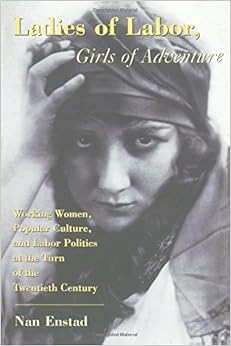
Ladies of Labor, Girls of Adventure: Working Women, Popular Culture, and Labor Politics at the Turn of the Twentieth Century

Free Ebook Ladies of Labor, Girls of Adventure: Working Women, Popular Culture, and Labor Politics at the Turn of the Twentieth Century
Exceptional Ladies Of Labor, Girls Of Adventure: Working Women, Popular Culture, And Labor Politics At The Turn Of The Twentieth Century publication is consistently being the very best buddy for spending little time in your workplace, night time, bus, and anywhere. It will certainly be a good way to merely look, open, as well as review guide Ladies Of Labor, Girls Of Adventure: Working Women, Popular Culture, And Labor Politics At The Turn Of The Twentieth Century while because time. As known, experience and ability don't always had the much cash to acquire them. Reading this publication with the title Ladies Of Labor, Girls Of Adventure: Working Women, Popular Culture, And Labor Politics At The Turn Of The Twentieth Century will allow you understand much more points.
When other people have started to review guides, are you still the one that consider ineffective task? Don't bother, reading practice can be grown once in a while. Lots of people are so hard to start to such as analysis, Additionally reviewing a book. Book may be a ting to display only in the rack or library. Publication might be just a point likely pillow for your resting. Today, we have different feature of the book to check out. Ladies Of Labor, Girls Of Adventure: Working Women, Popular Culture, And Labor Politics At The Turn Of The Twentieth Century that we offer here is the soft data.
In this instance, investing more time to check out the Ladies Of Labor, Girls Of Adventure: Working Women, Popular Culture, And Labor Politics At The Turn Of The Twentieth Century page by web page could hold the best function of analysis. This is one of the means for you who actually intend to take the easy reading as the referred activity. You can obtain the book to supply likewise for your friends as the book to refer. Again, this subject of the book will certainly give you matched lesson to the topic.
When you are taking a trip for somewhere, this suffices to bring always this publication that can be saved in gizmo in soft data system. By saving it, you can load the time in the train, vehicle, or other transportation to check out. Or when you have spare time in your holiday, you can spend couple of for reading Ladies Of Labor, Girls Of Adventure: Working Women, Popular Culture, And Labor Politics At The Turn Of The Twentieth Century So, this is really appropriate to review each time you could materialize of it.
Review
Enstad's imaginative reading of the goods consumed by working-class women in New York City at the turn of the twentieth century offers a fresh and illuminating perspective on and advances our understanding of the lived experience of work and leisure in the Gilded Age and Progressive era. (Nancy Gabin American Historical Review)Ladies of Labor represents an important contribution to labor, immigration and women's history that is anchored in the broader political economy of culture at the turn of the century. Enstad's skillful, multidisciplinary rendering of working women's lives should help us re-evaluate the ways we teach and write about popular culture and politics in America. (American Studies)
Read more
From the Back Cover
At the beginning of the twentieth century, women labor leaders routinely chastised young, female workers for their ceaseless pursuit of fashion, avid reading of dime novels, and "affected" ways, including aristocratic airs and accents. While the leading organizers feared that consumerist tendencies made these women frivolous and dissuaded them from political action, these women, in fact, went on strike in very large numbers during the period, demonstrating alternative political styles and identities. Examining a range of popular material, including early dime novels about ordinary women who marry millionaires, serial motion pictures featuring the hair-raising adventures of working-class heroines, and inexpensive, ready-to-wear clothing that allowed women to both deny and resist mistreatment in the workplace, author Nan Enstad analyzes how working women wove popular narratives and fashions into their developing sense of themselves as "ladies". While consumerism itself did not make these women into radicals, it did allow them to shape their culture and their identities as both workers and political actors.
Read more
See all Editorial Reviews
Product details
Paperback: 320 pages
Publisher: Columbia University Press (June 15, 1999)
Language: English
ISBN-10: 0231111037
ISBN-13: 978-0231111034
Product Dimensions:
6 x 0.6 x 9 inches
Shipping Weight: 1.1 pounds (View shipping rates and policies)
Average Customer Review:
3.4 out of 5 stars
4 customer reviews
Amazon Best Sellers Rank:
#407,885 in Books (See Top 100 in Books)
Good iteam
Bored me to tears! I highly recommend this book for insomniacs, it will put you to sleep.The most interesting thing about it is the cover photo.
In "Ladies of Labor, Girls of Adventure: Working Women, Popular Culture, and Labor Politics at the Turn of the Twentieth Century", Nan Enstad argues, “Consumer culture offered working-class women struggling with extremely difficult material and ideological constraints a new range of representations, symbols, activities, and spaces with which to create class, gender, and ethnic identities†(pg. 6). In this way, “For middle-class women, fashion served as a display of class distinction and taste, a cultural marker of privilege that differentiated them from working-class women and women of color. When working-class women dressed in elaborate styles, they staged a carnivalesque class inversion that undermined middle-class efforts to control the definition of ‘lady’†(pg. 10). Enstad further argues, “Working women used popular culture as a resource to lay claim to dignified identities as workers, sometimes from the very terms used by others to degrade them†(pg. 13). Addressing the historiography, Enstad argues that a reassessment of political activism and popular culture “is needed to understand how working-class women shaped their experiences in both realms†(pg. 14). Enstad builds largely upon Kathy Peiss’ "Cheap Amusements" while incorporating Judith Butler’s theories of gender and the work of film scholars.Enstad writes, “Working women’s relationship to consumerism, then, was shaped in part by the effects of production already inhering in the goods they bought. This is not to say that working women simply imbibed ideological messages conveyed by these commodities; on the contrary, they wound the products into their own social context and imbued them with their own meanings. However, the workings of the market dramatically shaped the range and nature of the commodities available to working women†(pg. 19). In terms of book publication, “Producers added working female heroines to the ranks of dime novels’ central characters in part because of increased newspaper coverage of women’s wage work†(pg. 38). Enstad continues, “Domestic fiction bore structural resemblances to the dime novel romances, but middle-class women insisted that their fiction, like their fashion, differed from commodities consumed primarily by the working class because of its moral value†(pg. 41). In this way, “The nature of these commodities was contradictory: they were richly laden with cultural connotations and available for a variety of readings and uses in working women’s daily lives†(pg. 47).Enstad writes, “Perhaps most disturbing was that working women incorporated their consumption of fashion and fiction into a social practice of calling and presenting themselves as ladies, complete with an affected style of speech, walk, and manners†(pg. 49). Turning to consumption, Enstad writes, “Working women’s consumption of fiction and fashion engaged their identities as workers, as women, and as immigrants. Through their purchases, women used the money they had earned, thus participating in consumption as workers†(pg. 50). The discussion of these novels helped women establish a common rapport amongst their fellow workers. Enstad writes, “Working women, however, did not simply imbibe wish images embedded in the dime novel narratives and the fashion products; they enacted wish images when they made themselves into ladies†(pg. 69). There was a further subversive aspect to these novels, as Enstad writes, “In the dime novels, true ladies exhibited bravery and strength, as well as beauty and charm – that is, ladyhood included a transgression of gender norms†(pg. 76).Enstad argues, “The public debate about the strike, including labor leaders’ contributions, constricted the intelligibility of working ladies’ own attempts to claim formal political subjectivities. That is, existing ideals of what a political subject looked like obscured working ladies’ identities†(pg. 86). Further, “Working women collectively created the cultural practices of ladyhood from the addresses of the fashion industry, employers, native-born Americans, and middle-class women. Indeed, as ladyhood became established and shared, working women interpellated others into it†(pg. 110). In terms of film, Enstad argues, “Theaters and the range and content of films themselves regularly replicated hierarchies working women found elsewhere in society. Nevertheless, women’s social practices of motion picture consumption generated new resources for the creation of public identities†(pg. 163). Further, “Women’s social practices of film consumption thus created a collective culture connected to their consumption of other commodities, such as dime novels and fashion. Film became more than an object or a narrative in women’s lives; it became part of their imaginative landscape – or collective dreamworld – and as such was integral to their enacted identities†(pg. 186).Enstad concludes, “Working women embraced dime novels, fashion, and film products and used them to create distinctive and pleasurable social practices and to enact identities as ladies. Consumer culture producers thus profited from the women’s capacity to imagine and create, even as factory bosses sought to remove those abilities from women’s daily part in the production process†(pg. 202). Critiquing the historiography, she writes, “The analytical binary between consumerism and politics creates a myth of a rational political actor who does not obtain an identity within commodity culture, and precludes understanding the diverse paths to political identities†(pg. 205).
Enstad takes U.S. women's history in important new directions because she understands how young working-class women created their own class-conscious identity in terms made available by consumer culture. In this context hats, shoes and pulp-fiction gave working-class women fun, spunky ways to of asserting themselves and their interests. Alas, at the time, neither male union activists nor middle-class women allies understood these young girls' politics, and the union movement suffered for its misunderstanding. But Enstad understands these girls perfectly. In Enstad's analysis movies and fashion become political--as they in fact were. And thanks to her explanation I finally understand why my feisty Jewish grandmothers insisted on calling themselves and their friends "ladies." A must-read for anybody who loves the new women's history.
Ladies of Labor, Girls of Adventure: Working Women, Popular Culture, and Labor Politics at the Turn of the Twentieth Century PDF
Ladies of Labor, Girls of Adventure: Working Women, Popular Culture, and Labor Politics at the Turn of the Twentieth Century EPub
Ladies of Labor, Girls of Adventure: Working Women, Popular Culture, and Labor Politics at the Turn of the Twentieth Century Doc
Ladies of Labor, Girls of Adventure: Working Women, Popular Culture, and Labor Politics at the Turn of the Twentieth Century iBooks
Ladies of Labor, Girls of Adventure: Working Women, Popular Culture, and Labor Politics at the Turn of the Twentieth Century rtf
Ladies of Labor, Girls of Adventure: Working Women, Popular Culture, and Labor Politics at the Turn of the Twentieth Century Mobipocket
Ladies of Labor, Girls of Adventure: Working Women, Popular Culture, and Labor Politics at the Turn of the Twentieth Century Kindle

Tidak ada komentar :
Posting Komentar