Download PDF Modern Art and the Life of a Culture: The Religious Impulses of Modernism (Studies in Theology and the Arts), by Jonathan A. Anderson
Besides, this publication is likewise written by one of one of the most prominent writer in the country. So, when you appreciate the writer a lot, it will certainly finish the collections of the compositions. Yet, when you are not extremely fan of the author, you could still fall for Modern Art And The Life Of A Culture: The Religious Impulses Of Modernism (Studies In Theology And The Arts), By Jonathan A. Anderson due to the fact that you will recognize how the writer informs the material to the visitors and culture. You can make manage this publication as one of referred information to earn you feel appreciated so much with this book.
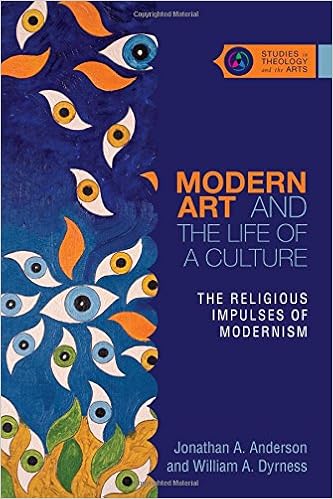
Modern Art and the Life of a Culture: The Religious Impulses of Modernism (Studies in Theology and the Arts), by Jonathan A. Anderson

Download PDF Modern Art and the Life of a Culture: The Religious Impulses of Modernism (Studies in Theology and the Arts), by Jonathan A. Anderson
Success is an option. It's just what many individuals claim as well as suggest making others be prospering. When somebody makes a decision to be success, they will attempt huge initiative to realize. Many methods are planned and undergone. Nothing restricted, but there is something that might b forgotten. Seeking for expertise as well as experience must remain in the strategy and also process. When you always more these two, you can complete your strategies.
As one of guides that have been written, Modern Art And The Life Of A Culture: The Religious Impulses Of Modernism (Studies In Theology And The Arts), By Jonathan A. Anderson will be just different with the previous book version. It includes the straightforward words that can be reviewed by all aspects. When you should know even more about the writer, you could review the bibliography of the author. It will certainly aid you to earn certain concerning this publication that you will certainly get as not just recommendation yet additionally as checking out source.
To understand how the book will be, it will be communicated with the performance and also look of guide. The subject of guide that you wish to review ought to be connected to the topic that you require or the subject that you such as. Reviewing typical publication will not be interested for you also you have held in on your hands. This is one issue to always solve. Yet here, when getting Modern Art And The Life Of A Culture: The Religious Impulses Of Modernism (Studies In Theology And The Arts), By Jonathan A. Anderson as referral, you may not fret anymore.
So, all people that read Modern Art And The Life Of A Culture: The Religious Impulses Of Modernism (Studies In Theology And The Arts), By Jonathan A. Anderson will certainly seem like doing the things on their own. It depends upon exactly how the readers look and consider this publication. However, generally, it actually showcases the remarkable ideas of guide analysis. It will also provide you the amazing systems of imagination. Naturally, it will certainly serve you far better idea of excellences. It is why we always offer you the best publication that can make your life much better. Now, really feel the life to get the outstanding methods of book accomplishment.
Review
"As insightful as Hans Rookmaaker's provocative book Modern Art and the Death of a Culture (1970) was in tracing with broad strokes his concern with the cultural demise of Christian values in the post-Enlightenment West, Anderson and Dyrness make probing and illuminating use of the forty-five years of subsequent research to show that the sacred and secular have been far more complexly interwoven than Rookmaaker recognized. The authors, using the same end date, open up a broad spectrum of well-researched and illuminating contextual material that serves as a needed corrective to Rookmaaker's generalized schema and models a multidisciplinary, art-historical and theological approach that is deliberately generous, open and sympathetic rather than confrontational."--E. John Walford, professor emeritus of art history, Wheaton College"This book signals an important mid-course correction in evangelical scholarship about modern art and it should become a staple textbook in college and seminary classes."--Gregory Wolfe, Image Journal, October 2016"Just what should Christians think of modern art? Is it void of all religious impulses and persuasions? Or is there a deeper vision often left unexplored? Rather than writing off the last century and a half of visual art as purely secular, Anderson and Dyrness meticulously detail the patterns of piety and spirituality that both influenced and empowered artists like van Gogh, Gauguin, Kandinsky, and Warhol."--Wade Bearden, Christianity Today, The 2017 Book Awards
Read more
Book Description
"Despite his often biting criticism and emphatic rejections of modern art, those who read Hans Rookmaaker closely know that the care and attentiveness he displayed in engaging the art of his day intimated a valuation far beyond mere condemnation. The same spirit of eager and attentive hospitality can be seen in this rejoinder by Bill Dyrness and Jon Anderson. With the studied investment in their diverse subjects and the poignant reflections emerging throughout, they have demonstrated that both Rookmaaker's vocation and burden are live categories for our time. More than a response to the original, Modern Art and the Life of a Culture is an invaluable companion to Rookmaaker and essential reading for any serious Christian encounter with modern art." (Taylor Worley, associate professor of faith and culture, Trinity International University)"This is a book we have needed for a long time. The standard story of modern art, told by religious and non-religious people alike, is that it is the art of secularism and pervaded by nihilism. That was the story told by Hans Rookmaaker more than forty years ago in the book that became enormously influential among evangelicals, Modern Art and the Death of a Culture. Anderson and Dyrness tell a very different story. They show that modern art has been pervaded by religious concerns and theological issues. What they have dug up is truly amazing; the book is an eye-opener. They frame their story as a response to Rookmaaker. But the story they tell and the interpretations they offer are for everyone. Only those who refuse to read can ever again think of modern art in the old way." (Nicholas Wolterstorff, Noah Porter Professor Emeritus of Philosophical Theology, Yale University, senior research fellow, Institute for Advanced Studies in Culture, University of Virginia)"As insightful as Hans Rookmaaker's provocative book Modern Art and the Death of a Culture (1970) was in tracing with broad strokes his concern with the cultural demise of Christian values in the post-Enlightenment West, Anderson and Dyrness make probing and illuminating use of the forty-five years of subsequent research to show that the sacred and secular have been far more complexly interwoven than Rookmaaker recognized. The authors, using the same end date, open up a broad spectrum of well-researched and illuminating contextual material that serves as a needed corrective to Rookmaaker's generalized schema and models a multidisciplinary, art-historical and theological approach that is deliberately generous, open and sympathetic rather than confrontational." (E. John Walford, professor emeritus of art history, Wheaton College)
Read more
See all Editorial Reviews
Product details
Series: Studies in Theology and the Arts
Paperback: 376 pages
Publisher: IVP Academic; 1 edition (June 24, 2016)
Language: English
ISBN-10: 9780830851355
ISBN-13: 978-0830851355
ASIN: 0830851356
Product Dimensions:
6 x 1 x 8.9 inches
Shipping Weight: 1.2 pounds (View shipping rates and policies)
Average Customer Review:
4.4 out of 5 stars
7 customer reviews
Amazon Best Sellers Rank:
#234,542 in Books (See Top 100 in Books)
Very good and very welcomed book on a VERY important topic still neglected by the vast majority of Christians and artists alike.First point - neither Anderson (who has a Masters in fine arts) nor Dyrness are Art Historians like Rookmaaker was (much of their book rightly seeks to overturn much of what Rookmaaker wrote about in the 1970s). I am 39 and have a master in classical history so I feel I am the appropriate age as well as mindset to say the authors are about 50% right in their challenges to Rookmaaker but they are also about 50% wrong (or guilty of setting up "red-herring" oriented arguments that obviously Rookmaaker can not answer to since he is dead).Overall a very good read going in the right direction but neither author has the same credentials Rookmaaker did nor are about half of their points of contention well established; instead there are a lot of "assertions" without good philosophy of art or historiography to back them up. Highly recommended but definitely the weakest in the "studies in theology and the arts" series. I still highly recommend you read this book as well as Rookmaaker's original but I just wish they would have had an actual art historian or even philosopher of art contribute; many great points but like I said about half of their points were more ad hoc when they expressed their "feelings" on why Rookmaaker was mistaken in certain points.
This is the text for a discussion group I have subscribed to through Biola University. It is great to have other Art knowledgeable folk to bounce this off of. Also the author, Jonathan Anderson, participates. These authors present a pro-Judeo/Christian spiritual perspective on the content and effect of the artwork that has come from modernism.
A great viewpoint on the sacred and secular and where they meet. A great voice and filled with beautiful imagery and information.
Enlightening, encouraging, and a deeper view of the lives of many artists than is usual. I've waited a long time for a follow up book to Rookmaaker's Art and the Death of a Culture. This does not disappoint.
Jonathan Anderson and William Dyrness analyze how modern art reflects the cultural mindset in Modern Art and the Life of a Culture, the inaugural entry in a new series on Studies in Theology and the Arts from InterVarsity Press. The most important thing is whether the book will be of interest to those who have little-to-no training in arts or theology. That is, can the book really bridge the gap between these fields? As one trained in theology, but with only the most introductory (read: general studies requirements) knowledge of art, from that side, I’d say the answer is a resounding yes.Anderson and Dyrness explore modern art through the lens of H.R. Rookmaaker’s Modern Art and the Death of a Culture. However, they are not uncritical of this source material. Rookmaaker, they argue, was too quick to see more points of contact between Christianity and modern art than might be intended. However, Rookmaaker also provided a paradigm for viewing works of art as the basis for critical interaction rather than the life of or intentions of the artists themselves. This paradigm is quite useful, but it would be remiss to completely ignore the intent or life of the artist when looking at a work of art. It is this latter point which carries throughout the book, as the authors look at individual works of art, critically reflecting on them while also giving a holistic view of the artists themselves.These descriptions are never boring or overdone. The authors write in an engaging style that weaves theology and art together in ways that are often surprising and frequently thought-provoking. The artists included are from a range of theological background and understandings. Thus, the book provides a broad look at different geological regions and their art from about the 1800s on (with some dabbling into earlier periods) that will give readers a working understanding of how the development of these styles interacted with the surrounding culture. At times, these stories are fascinating–how did the aristocracy or church react to differing depictions of icons in Russia, for example–and they always provide needed background and concrete examples.The book also includes a number of full-color pictures to examine which are integrated into the text in useful ways. They are beautiful and often haunting. If there is one critique I may offer of the book, it is that more pictures would have been helpful. Some chapters have almost no images. Some have only black-and-white pictures. It is great to have more pictures, but the black-and-white ones make it a little difficult to discern details. More pictures would have helped readers like me–untrained in the arts–to get a better grasp on what some parts of the text were discussing. I looked up multiple paintings and images online to get a better understanding, but having them included in the text would have made it an even more excellent resource.What is perhaps most important in the book, however, is the critical perspective the authors offer. It is impossible to give a wholesale acceptance or rejection of a field of art, and the authors provide ways to engage with both individuals and single pieces of art in ways that go beyond simply looking at the painting. It can be said, honestly, that the book will make readers want to go out, look at art, and let it speak to them in new and more profound ways. To say that about a book intended to get Christians thinking theologically about art is to give it the highest praise.Modern Art and the Life of a Culture provides an excellent way to kick off a series on theology and the arts. It is engaging, eye-opening, and beautiful. Readers from many fields will find things of interest, and the authors provide numerous points of contact for future study. It is a highly recommended work.The Good+Introduces reader to an array of topics+Critical interaction with source material+Provides example of art criticism from Christian perspective+Draws from international sources+Includes beautiful color artworkThe Bad-Difficult to discern some details in the black and white picturesDisclaimer: I received a review copy of this book from the publisher. I was not required to provide any specific kind of review whatsoever.SourceJonathan Anderson and William Dyrness, Modern Art and the Life of a Culture (Downers Grove, IL: InterVarsity, 2016).
Modern Art and the Life of a Culture: The Religious Impulses of Modernism (Studies in Theology and the Arts), by Jonathan A. Anderson PDF
Modern Art and the Life of a Culture: The Religious Impulses of Modernism (Studies in Theology and the Arts), by Jonathan A. Anderson EPub
Modern Art and the Life of a Culture: The Religious Impulses of Modernism (Studies in Theology and the Arts), by Jonathan A. Anderson Doc
Modern Art and the Life of a Culture: The Religious Impulses of Modernism (Studies in Theology and the Arts), by Jonathan A. Anderson iBooks
Modern Art and the Life of a Culture: The Religious Impulses of Modernism (Studies in Theology and the Arts), by Jonathan A. Anderson rtf
Modern Art and the Life of a Culture: The Religious Impulses of Modernism (Studies in Theology and the Arts), by Jonathan A. Anderson Mobipocket
Modern Art and the Life of a Culture: The Religious Impulses of Modernism (Studies in Theology and the Arts), by Jonathan A. Anderson Kindle

Tidak ada komentar :
Posting Komentar